

Roof Inspection Checklist: What Roofers Look for During an Inspection
Most people call a roofer after they see something. A shingle in the yard after a storm, a lifted edge visible from the driveway, a stain spreading across a bedroom ceiling. By then the problem has usually been developing for months.
The damage that costs the most is the damage you can’t see from the ground. A cracked flashing joint, a shingle that lost its seal, a ridge vent sitting a quarter inch off the deck. None of these announce themselves until water is already inside.
This is what a roofing contractor actually looks at during an inspection, and what each finding means for your roof.
What’s on this page
Signs Your Shingles Are Wearing Out
Shingles are the first thing we look at, because they show wear before anything else does. Three patterns tell us most of what we need to know.
Granule Loss

Those granules are the shingle’s armor. They take the UV hit, the rain, and the hail so the asphalt underneath doesn’t have to. Once they’re gone from a patch, that spot dries out, cracks, and degrades far faster than the rest of the roof.
Finding granules in your gutters after a storm is normal, since some shed throughout a roof’s life. What matters is the bald spots left behind. Widespread bare patches usually mean the roof is entering the last stretch of its service life, and we’ll talk with you about whether targeted repair still makes sense or whether you’re better off planning a full replacement.
Loose, Lifted, or Missing Shingles
A missing shingle is obvious. The dangerous ones are the shingles still in place but no longer sealed.
Asphalt shingles bond to each other with an adhesive strip that softens in the heat and locks down. Wind can break that bond without moving the shingle far enough to notice from the ground. The shingle looks fine. It just isn’t attached anymore, and wind-driven rain now has a path underneath it.
We check for raised nail heads, corners that lift under hand pressure, and gaps along the seal line. Resealing a handful of shingles is a small job. Replacing a section of rotted decking eighteen months later is not.
Curling and Cracking

Shingles expand and contract with every temperature swing. Over enough cycles the material fatigues, and you get curling at the edges or splits running through the face.
Heat from below accelerates this dramatically. An attic that runs 150°F in July is cooking your shingles from the underside while the sun works on the top. This is why attic ventilation shows up in a shingle conversation. Poor airflow ages a roof from the inside out.
The sealant in the photo above is worth noting. Someone applied a bead along the crack to buy time. It works for a season or two, then the sealant hardens, separates from the shingle, and water finds the same path it was always going to find. Sealant is a bridge to a repair, not a substitute for one.
Flashing and Water Intrusion
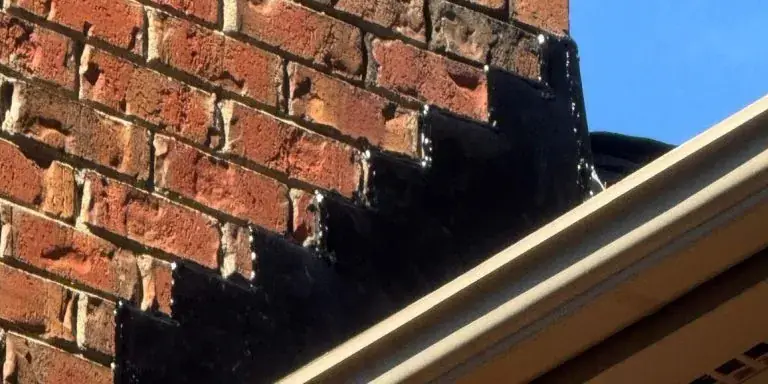
Flashing is the metal that protects every place your roof meets something else: a wall, a chimney, a skylight, a vent pipe. These transitions are where the majority of roof leaks begin, and flashing is the only thing standing between them and your framing.
Done correctly, step flashing is a series of individual L-shaped metal pieces, each one woven into a course of shingles and overlapping the piece below. Water hits it and gets guided down and out. No sealant required.
The chimney above shows what we find far more often: someone troweled roofing cement over the whole assembly. Tar is not flashing. It’s rigid where flashing needs to move, it shrinks and cracks within a couple of seasons, and it hides the condition of the metal underneath so nobody can tell how bad things have gotten. When we see a black chimney, we assume there’s a problem being covered up until we can prove otherwise.
During an inspection we’re checking for rust, separated joints, flashing that was reused from a previous roof, missing counterflashing at masonry, and exactly this kind of tar patching. Any of these means water is getting behind the system. See our roof repair services for how these get corrected.
Ventilation and Attic Health

Ventilation is a loop, and it needs both halves to work. Cool air enters low through the soffit vents at your eaves. Hot air exits high through the ridge. Break either end and the whole system stalls.
The half almost everyone gets wrong is intake. Blown-in insulation packed into the eaves seals off the soffit vents from inside the attic. The vents are still visible from the ground, they’re just no longer connected to anything. A ridge vent with no intake below it is a straw with your thumb over the end.
We also check for mixed exhaust types. If a roof has a ridge vent and box vents on the same attic space, the ridge vent pulls air from the box vents a few feet below rather than from the soffits thirty feet away. The top of the attic cycles, the bottom two-thirds sits stagnant. When we install a ridge vent, the old box vents get closed off, because leaving them open makes the new vent worse than useless.
Under-ventilated attics produce premature shingle failure in summer and condensation, mold, and rotted decking in winter. It’s also a warranty issue: most shingle manufacturers require adequate ventilation for coverage to hold. Read more about ridge vents and roof ventilation, or check what our warranty covers.
Not sure what’s happening on your roof?
We inspect for free and tell you straight, including when the answer is “you don’t need anything yet.”
What We Look For After a Storm

Hail doesn’t have to be large to damage a roof. Pea-sized stones hitting at the right angle knock granules loose and bruise the mat beneath, and that spot begins failing immediately even though the shingle looks intact from ten feet away.
This is the single most important thing to understand about storm damage: it usually doesn’t leak right away. The bruised area weathers faster than the rest of the roof, and eighteen months to two years later you have a leak. By then, most insurance carriers’ claim windows have closed.
The circular mark in the photo is exactly what a roofer and an insurance adjuster are both looking for. Documenting it soon after the storm is what makes a claim viable.
If a storm has come through your area, get the roof looked at while the timeline still works in your favor. We handle storm damage inspections and insurance claims, including in Suwanee and the north Atlanta metro and greater Cincinnati. For active leaks, we also offer emergency roof repair.
Gutters and Drainage

Gutters exist to move water off the roof and away from the foundation. When they stop doing that, the evidence shows up on your walls before it shows up anywhere else.
The photo above is a textbook case. Dark streaking down the brick, algae taking hold in the damp, staining at the soffit and fascia. Something upstream is failing: a clog holding water in the trough, a separated seam, a missing kickout flashing where the roof edge meets the wall, or a gutter pitched wrong so water pools instead of draining.
Left alone this progresses predictably: fascia board rot, then soffit rot, then water tracking into the wall assembly. Outside, standing water at the foundation erodes soil and finds its way into basements and crawlspaces.
During an inspection we check for sagging runs, separated corners, loose hangers, downspouts discharging too close to the foundation, and staining like this that points to a problem you can’t see from the top. Learn more about gutters, downspouts, and gutter covers.
Interior Warning Signs

Sometimes the first evidence is inside. Ring-shaped ceiling stains, bubbling or blistering paint, a soft spot in drywall, a musty smell in an upstairs room.
One thing worth knowing: the stain is rarely under the leak. Water enters at a penetration or a failed flashing joint, travels along a rafter or the top of the ceiling drywall, and drops wherever it finds a low point. That can be fifteen feet from where it got in. It’s why “just patch the ceiling” doesn’t fix anything.
In the attic we look for damp or compressed insulation, dark staining on the underside of the decking, rusted nail tips (a condensation signal), and any active mold. Moisture up there without an obvious leak usually points back to ventilation.
Regional Factors: Charlotte, Atlanta, and Cincinnati
Climate determines which failures show up first.
Charlotte, North Carolina
Heavy convective rain and a real hail season. Flashing details and shingle seal integrity get checked hardest here, and post-storm documentation matters because claim timelines are unforgiving. See our Charlotte roofing services.
Atlanta and North Georgia
High humidity year-round drives algae growth, those dark streaks running down north-facing slopes, and makes ventilation performance critical, since a humid attic with no airflow is a mold incubator. See our Atlanta roofing services and Suwanee location.
Cincinnati, Ohio
Freeze-thaw cycling is the defining stress. Water gets into a hairline crack, freezes, expands, and widens it, repeatedly, all winter. Ice damming at the eaves is the other recurring issue, and it’s almost always a ventilation and insulation problem rather than a shingle problem. See our Cincinnati roofing services.
How Often Should You Schedule an Inspection?
The general guidance:
- Once a year once the roof passes about eight years old
- After any significant storm: hail of any size, or sustained winds above roughly 50 mph
- Before buying or selling a property
- Before your manufacturer warranty period ends, while defects are still covered
There’s a documentation argument for this too. A dated inspection record establishing your roof’s condition before a storm is often what separates an approved claim from a denied one. Adjusters look for pre-existing wear, and having your own record helps.
Routine attention also catches the cheap fixes while they’re still cheap. A resealed shingle, a replaced boot, a cleared gutter. None of these are expensive. The decking replacement they prevent is. Our roof maintenance program covers this on a schedule.
What to Do If You Suspect Damage
Get it inspected before you do anything else, including before you file a claim.
Filing without knowing what’s actually wrong can work against you. A denied claim goes on your record, and if the damage turns out to be maintenance-related rather than storm-related, you’ve spent a claim for nothing. A contractor who can document the damage properly and tell you whether it’s a covered event puts you in a much stronger position.
And stay off the roof. Beyond the obvious fall risk, walking a damaged roof causes more granule loss and can complicate a claim by muddying what the storm did versus what foot traffic did.
Schedule a Free Roof Inspection
Kaiser Siding and Roofing inspects, repairs, and replaces roofs across Charlotte, Atlanta, and Cincinnati. We’re BBB Accredited and an Owens Corning Platinum Preferred Contractor.
No cost, no obligation, and an honest answer, including when that answer is that your roof is fine.
Most people call a roofer after they see something. A shingle in the yard after a storm, a lifted edge visible from the driveway, a stain spreading across a bedroom ceiling. By then the problem has usually been developing for months.
The damage that costs the most is the damage you can’t see from the ground. A cracked flashing joint, a shingle that lost its seal, a ridge vent sitting a quarter inch off the deck. None of these announce themselves until water is already inside.
This is what a roofing contractor actually looks at during an inspection, and what each finding means for your roof.
What’s on this page
Signs Your Shingles Are Wearing Out
Shingles are the first thing we look at, because they show wear before anything else does. Three patterns tell us most of what we need to know.
Granule Loss
Those granules are the shingle’s armor. They take the UV hit, the rain, and the hail so the asphalt underneath doesn’t have to. Once they’re gone from a patch, that spot dries out, cracks, and degrades far faster than the rest of the roof.
Finding granules in your gutters after a storm is normal, since some shed throughout a roof’s life. What matters is the bald spots left behind. Widespread bare patches usually mean the roof is entering the last stretch of its service life, and we’ll talk with you about whether targeted repair still makes sense or whether you’re better off planning a full replacement.
Loose, Lifted, or Missing Shingles
A missing shingle is obvious. The dangerous ones are the shingles still in place but no longer sealed.
Asphalt shingles bond to each other with an adhesive strip that softens in the heat and locks down. Wind can break that bond without moving the shingle far enough to notice from the ground. The shingle looks fine. It just isn’t attached anymore, and wind-driven rain now has a path underneath it.
We check for raised nail heads, corners that lift under hand pressure, and gaps along the seal line. Resealing a handful of shingles is a small job. Replacing a section of rotted decking eighteen months later is not.
Curling and Cracking
Shingles expand and contract with every temperature swing. Over enough cycles the material fatigues, and you get curling at the edges or splits running through the face.
Heat from below accelerates this dramatically. An attic that runs 150°F in July is cooking your shingles from the underside while the sun works on the top. This is why attic ventilation shows up in a shingle conversation. Poor airflow ages a roof from the inside out.
The sealant in the photo above is worth noting. Someone applied a bead along the crack to buy time. It works for a season or two, then the sealant hardens, separates from the shingle, and water finds the same path it was always going to find. Sealant is a bridge to a repair, not a substitute for one.
Flashing and Water Intrusion
Flashing is the metal that protects every place your roof meets something else: a wall, a chimney, a skylight, a vent pipe. These transitions are where the majority of roof leaks begin, and flashing is the only thing standing between them and your framing.
Done correctly, step flashing is a series of individual L-shaped metal pieces, each one woven into a course of shingles and overlapping the piece below. Water hits it and gets guided down and out. No sealant required.
The chimney above shows what we find far more often: someone troweled roofing cement over the whole assembly. Tar is not flashing. It’s rigid where flashing needs to move, it shrinks and cracks within a couple of seasons, and it hides the condition of the metal underneath so nobody can tell how bad things have gotten. When we see a black chimney, we assume there’s a problem being covered up until we can prove otherwise.
During an inspection we’re checking for rust, separated joints, flashing that was reused from a previous roof, missing counterflashing at masonry, and exactly this kind of tar patching. Any of these means water is getting behind the system. See our roof repair services for how these get corrected.
Ventilation and Attic Health
Ventilation is a loop, and it needs both halves to work. Cool air enters low through the soffit vents at your eaves. Hot air exits high through the ridge. Break either end and the whole system stalls.
The half almost everyone gets wrong is intake. Blown-in insulation packed into the eaves seals off the soffit vents from inside the attic. The vents are still visible from the ground, they’re just no longer connected to anything. A ridge vent with no intake below it is a straw with your thumb over the end.
We also check for mixed exhaust types. If a roof has a ridge vent and box vents on the same attic space, the ridge vent pulls air from the box vents a few feet below rather than from the soffits thirty feet away. The top of the attic cycles, the bottom two-thirds sits stagnant. When we install a ridge vent, the old box vents get closed off, because leaving them open makes the new vent worse than useless.
Under-ventilated attics produce premature shingle failure in summer and condensation, mold, and rotted decking in winter. It’s also a warranty issue: most shingle manufacturers require adequate ventilation for coverage to hold. Read more about ridge vents and roof ventilation, or check what our warranty covers.
Not sure what’s happening on your roof?
We inspect for free and tell you straight, including when the answer is “you don’t need anything yet.”
What We Look For After a Storm
Hail doesn’t have to be large to damage a roof. Pea-sized stones hitting at the right angle knock granules loose and bruise the mat beneath, and that spot begins failing immediately even though the shingle looks intact from ten feet away.
This is the single most important thing to understand about storm damage: it usually doesn’t leak right away. The bruised area weathers faster than the rest of the roof, and eighteen months to two years later you have a leak. By then, most insurance carriers’ claim windows have closed.
The circular mark in the photo is exactly what a roofer and an insurance adjuster are both looking for. Documenting it soon after the storm is what makes a claim viable.
If a storm has come through your area, get the roof looked at while the timeline still works in your favor. We handle storm damage inspections and insurance claims, including in Suwanee and the north Atlanta metro and greater Cincinnati. For active leaks, we also offer emergency roof repair.
Gutters and Drainage
Gutters exist to move water off the roof and away from the foundation. When they stop doing that, the evidence shows up on your walls before it shows up anywhere else.
The photo above is a textbook case. Dark streaking down the brick, algae taking hold in the damp, staining at the soffit and fascia. Something upstream is failing: a clog holding water in the trough, a separated seam, a missing kickout flashing where the roof edge meets the wall, or a gutter pitched wrong so water pools instead of draining.
Left alone this progresses predictably: fascia board rot, then soffit rot, then water tracking into the wall assembly. Outside, standing water at the foundation erodes soil and finds its way into basements and crawlspaces.
During an inspection we check for sagging runs, separated corners, loose hangers, downspouts discharging too close to the foundation, and staining like this that points to a problem you can’t see from the top. Learn more about gutters, downspouts, and gutter covers.
Interior Warning Signs
Sometimes the first evidence is inside. Ring-shaped ceiling stains, bubbling or blistering paint, a soft spot in drywall, a musty smell in an upstairs room.
One thing worth knowing: the stain is rarely under the leak. Water enters at a penetration or a failed flashing joint, travels along a rafter or the top of the ceiling drywall, and drops wherever it finds a low point. That can be fifteen feet from where it got in. It’s why “just patch the ceiling” doesn’t fix anything.
In the attic we look for damp or compressed insulation, dark staining on the underside of the decking, rusted nail tips (a condensation signal), and any active mold. Moisture up there without an obvious leak usually points back to ventilation.
Regional Factors: Charlotte, Atlanta, and Cincinnati
Climate determines which failures show up first.
Charlotte, North Carolina
Heavy convective rain and a real hail season. Flashing details and shingle seal integrity get checked hardest here, and post-storm documentation matters because claim timelines are unforgiving. See our Charlotte roofing services.
Atlanta and North Georgia
High humidity year-round drives algae growth, those dark streaks running down north-facing slopes, and makes ventilation performance critical, since a humid attic with no airflow is a mold incubator. See our Atlanta roofing services and Suwanee location.
Cincinnati, Ohio
Freeze-thaw cycling is the defining stress. Water gets into a hairline crack, freezes, expands, and widens it, repeatedly, all winter. Ice damming at the eaves is the other recurring issue, and it’s almost always a ventilation and insulation problem rather than a shingle problem. See our Cincinnati roofing services.
How Often Should You Schedule an Inspection?
The general guidance:
- Once a year once the roof passes about eight years old
- After any significant storm: hail of any size, or sustained winds above roughly 50 mph
- Before buying or selling a property
- Before your manufacturer warranty period ends, while defects are still covered
There’s a documentation argument for this too. A dated inspection record establishing your roof’s condition before a storm is often what separates an approved claim from a denied one. Adjusters look for pre-existing wear, and having your own record helps.
Routine attention also catches the cheap fixes while they’re still cheap. A resealed shingle, a replaced boot, a cleared gutter. None of these are expensive. The decking replacement they prevent is. Our roof maintenance program covers this on a schedule.
What to Do If You Suspect Damage
Get it inspected before you do anything else, including before you file a claim.
Filing without knowing what’s actually wrong can work against you. A denied claim goes on your record, and if the damage turns out to be maintenance-related rather than storm-related, you’ve spent a claim for nothing. A contractor who can document the damage properly and tell you whether it’s a covered event puts you in a much stronger position.
And stay off the roof. Beyond the obvious fall risk, walking a damaged roof causes more granule loss and can complicate a claim by muddying what the storm did versus what foot traffic did.
Schedule a Free Roof Inspection
Kaiser Siding and Roofing inspects, repairs, and replaces roofs across Charlotte, Atlanta, and Cincinnati. We’re BBB Accredited and an Owens Corning Platinum Preferred Contractor.
No cost, no obligation, and an honest answer, including when that answer is that your roof is fine.


